Corporate Social Responsibility (CSR) now plays a central role in organizational strategy. Although it has become more structured and regulated over the past ten years, the concept actually dates back to the 1950s.
At the beginning, CSR mainly took the form of philanthropy, sponsorship, or charitable activities, with no direct connection to a company’s core business or strategy. The economic, social, and environmental impacts of businesses were not yet part of the discussion.
1987 – The Brundtland Report
The Brundtland Report introduced the concept of sustainable development for the first time:
“Sustainable development is development that meets the needs of the present without compromising the ability of future generations to meet their own needs.”
This landmark text, endorsed by the United Nations, highlighted two key ideas: meeting essential needs—particularly those of the most disadvantaged—and recognizing the limits imposed by our technologies and social organization. It marked the beginning of a global reflection on balancing economic, environmental, and social concerns.
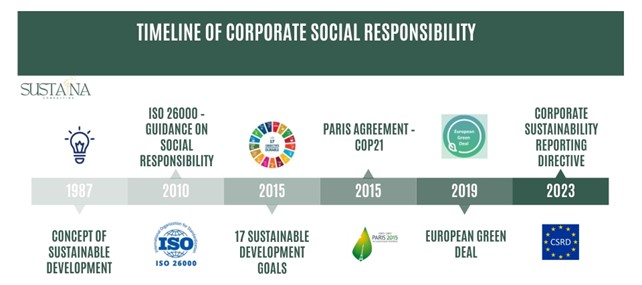
2010 – The ISO 26000 Standard
The international standard ISO 26000 provides a reference framework for CSR. It invites companies to reflect on seven key issues:
- governance,
- human rights,
- labor relations and working conditions,
- environment,
- fair operating practices,
- consumer protection,
- community involvement and local development.
This standard allows organizations wishing to commit to sustainability to adopt a more structured and consistent approach.
2015 – The Sustainable Development Goals and the Paris Agreement
Two major milestones reinforced the global sustainability agenda:
- The 17 Sustainable Development Goals (SDGs) set by the United Nations, a universal roadmap for 2030 covering issues such as climate, biodiversity, energy, water, poverty, gender equality, education, agriculture, prosperity, and peace.
- The Paris Agreement, signed at COP21 by 196 countries, with the aim of keeping global warming well below 2°C—and preferably under 1.5°C—compared to pre-industrial levels.
2019 – The European Green Deal
The European Commission announced its ambition to make Europe the first climate-neutral continent. The Green Deal sets out:
- a 55% reduction in greenhouse gas (GHG) emissions by 2030 (compared to 1990 levels),
- 90% by 2040,
- and full carbon neutrality by 2050.
This implies a profound transformation of production and consumption patterns, progressively translated into European directives and regulations.
2023 – The CSRD and the VSME
To accelerate corporate transition, the European Union adopted the Corporate Sustainability Reporting Directive (CSRD). This directive requires large companies to disclose detailed information on their actions, objectives, and results in the areas of environment, social responsibility, and governance (ESG). It also aims to guide investments toward sustainable projects.
In the same spirit, the Voluntary Sustainability Reporting Standard for non-listed SMEs (VSME) offers small and medium-sized enterprises a voluntary framework to commit and communicate transparently about their sustainability practices.
What’s Next?
CSR is a constantly evolving field. Business transformation has only just begun: raising awareness, informing, assessing, and taking action are essential steps to building a sustainable and responsible future for generations to come